

This article contains brief mentions of sensitive subjects such as suicide, trauma and violence.
Gremlins is a beloved Christmas classic – merging Spielbergian wonder in the vein of E.T, the Christmas spirit of films like It’s A Wonderful Life and golden age monster movies. Nearly 30 years since Gizmo arrived in Kingston Falls, Gremlins continues to be introduced to new generations and grown-up children alike.
The idea for Gremlins came from folklore. Derived from RAF myths about mischievous creatures which would cause damage to military aeroplanes, and popularised by the 1943 Roald Dahl children’s book The Gremlins.
A Christmas legend
Screenwriter Chris Columbus found his main inspiration’s stemmed from both this mythology and his own living conditions. Columbus was living in an apartment with rodent issues. He could hear mice come out at night and scamper around in the dark which he found to be unsettling. This gave him the core idea for his screenplay.
Columbus has went on to be somewhat of a Christmas legend, nearly directing National Lampoon’s Christmas Vacation, directing Home Alone and The Christmas Chronicles 2.
The Gremlins screenplay was originally thought by Columbus to be a throwaway spec script never to come to fruition. Then, it found its way onto the desk of none other than the legendary Steven Spielberg and was picked up by his new-found production company Amblin with Spielberg himself stepping on board as Executive Producer.
The Berg may have enjoyed Columbus’ script but wanted to make some revisions to make it more family-friendly, as nothing screams the holiday spirit like severed heads being thrown down stairs and dogs being eaten, both of which featured in the original draft of Gremlins.
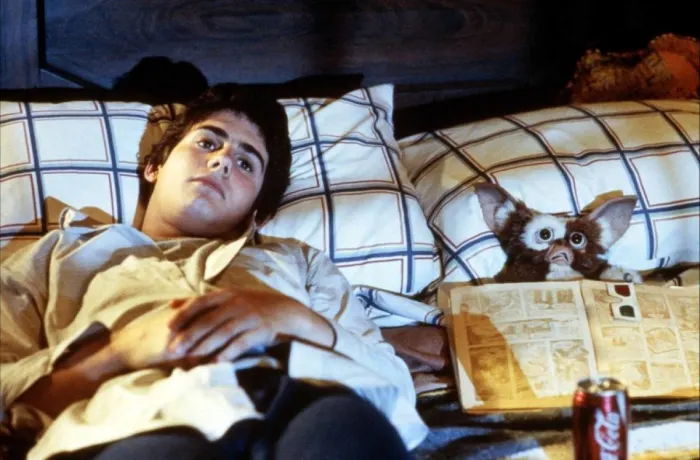
The film even managed to span some mythology of its own. Some claimed that the gremlins were originally to be portrayed by monkeys, a claim that sounds too wild to have actually happened, but nevertheless, is ingrained into the film’s production stories
A ratings nightmare
With cult favourite Joe Dante helming the director’s seat of the already stacked production team, Gremlins was set to be a sure-fire success, and it was. Released on June 8, 1984 – surprisingly nowhere close to Christmas – the film made $212.9 million worldwide despite being released on the same day as blockbuster-hit Ghostbusters.
Spielberg partly became responsible for the introduction of the PG-13 rating by the MPAA, as both Indiana Jones and The Temple of Doom and Gremlins were a rating conundrum under their current system at the time, too tame for an R rating but too inappropriate for a PG. After Spielberg met with the head of the rating board, the PG-13 tag was officially created.
Gremlins spun the traditional Christmas story on its head. Rather than portraying it’s small town of Kingston Falls as a jolly Christmas haven, it’s a place where bank managers have no sympathy for struggling families and characters such as Kate (Phoebe Cates) associate Christmas with familial trauma – a bizarre monologue reveals her father died in a Christmassy accident (a scene Dante insisted to keep, but Spielberg personally disliked) and heightened suicide rates (“While everyone else is opening their presents, they’re opening their wrists!”).
Then of course there are the stars of the film, the little green creatures themselves. They wreak havoc upon Kingston Falls – imitating carol singers, taking over a movie theatre & destroying houses.
In response to backlash by parents toward the film, Dante responded that, “the idea of taking a 4-year-old to see Gremlins, thinking it’s going to be a cuddly, funny animal movie and then seeing that it turns into a horror picture, I think people were upset.”
Gremlins everywhere!
However, this did not affect sales of children’s merchandise, particularly because of the appeal of Gizmo – the adorable, cuddly Mogwai given to Billy by his father as a Christmas present. Gizmo stuffed animals flew off the shelves, becoming one of the most in-demand toys during the holiday season of 1984. Gizmo even got his own furby spinoff.

Ironic given the film’s commentary on consumerism during the holiday season.
By removing the Mogwai from its correct habitat, Rand Peltzer’s appropriation of the creature ended up with huge consequences. The film warns people to think twice before gifting at Christmas – ‘a dog isn’t just for christmas’ if you will. While played for humour throughout the film, Peltzer’s many inventions are nothing more than him searching for the next big money-making scheme and sell to unconvinced shopkeepers. He even considers selling the Mogwai. Perhaps the invasion of the Gremlins themselves is a metaphor for the rampant spread of consumerism, fluffy and fun on the outside with a much more sinister core.
Gremlins is an unconventional Christmas classic which continues its legacy after 39 years on our screens. Always remember, avoid bright lights, don’t get them wet and whatever you do, don’t feed them after midnight.
Image credits: Amblin Entertainment

He/Him
Arts Editor 24/25
Press email: arts@brignews.com
